Contact Us : +91 9599564689 | Email: info@revamphealthcare.in | Working Hours : Mon-Sat, 10 AM-8PM

Iliotibial Band Syndrome Treatment Delhi NCR
What Is Iliotibial Band Syndrome?
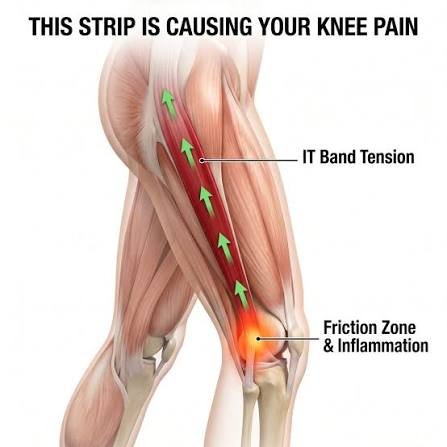
Iliotibial Band Syndrome (ITBS) is one of the most common causes of pain on the outside of the knee, particularly in runners, cyclists, and people involved in repetitive sports activities. It develops when the iliotibial (IT) band—a strong band of connective tissue running from the outside of the hip to just below the knee—becomes irritated due to repeated movement.
As the knee repeatedly bends and straightens, the IT band moves over the outer part of the thigh bone. Excessive tension or repetitive stress can irritate the surrounding tissues, leading to pain and inflammation. Although the discomfort is most often felt at the knee, some people also experience pain around the outer hip.
Symptoms
The most common symptom is pain on the outside of the knee, which usually begins during or after physical activity. Early symptoms may only occur toward the end of a workout, but if left untreated, the pain can develop earlier during exercise and may eventually occur even while resting.
Common symptoms include:
What Causes IT Band Syndrome?
The exact cause of IT band syndrome is still debated, but it is widely accepted that repetitive knee movement plays a significant role. Repeated bending and straightening of the knee may increase friction or compress the tissues beneath the IT band, resulting in irritation and pain.
Several factors may increase stress on the IT band, including:
These factors can increase tension on the IT band, making it more likely to become irritated during activity.
Risk Factors
Certain physical characteristics, such as weak hip muscles, excessive foot pronation, bowed legs, or leg length differences, may further increase the risk.
When to see a Specialist
Early evaluation helps identify underlying conditions and ensures timely treatment when needed.
How Is IT Band Syndrome Diagnosed?
Diagnosis usually begins with a detailed discussion of your symptoms, activity level, and medical history, followed by a physical examination.
During the examination, your clinician may check for:
Special clinical tests may be performed to evaluate IT band tightness and identify the source of pain.
Imaging studies such as X-rays, ultrasound, or MRI are not always necessary but may be recommended to rule out other causes of knee pain, such as meniscus injuries or ligament problems.
How Foot orthorics and custom insoles help in IT Band Syndrome?
Yes—custom foot orthoses (custom insoles) can play an important role in managing Iliotibial Band Syndrome (ITBS), especially when abnormal foot mechanics contribute to excessive stress on the knee and hip.Every person's foot shape, gait pattern, and biomechanics are unique. Problems such as overpronation (excessive inward rolling of the foot), poor foot alignment, or uneven weight distribution can increase the strain transmitted through the ankle, knee, and hip. Over time, these abnormal forces may place additional tension on the iliotibial band, leading to pain and inflammation.
Recovery & Outlook
Most people experience significant improvement with appropriate treatment. Recovery often occurs within 4 to 8 weeks, although some individuals recover sooner depending on symptom severity and adherence to rehabilitation. Returning to sports or exercise should be gradual and only after pain has resolved.
Reviewed By Dr Mohit Sharma - Clinical Head, Podiatrist, Foot Care Specialist on 22 July 2026