Achilles Tendinitis
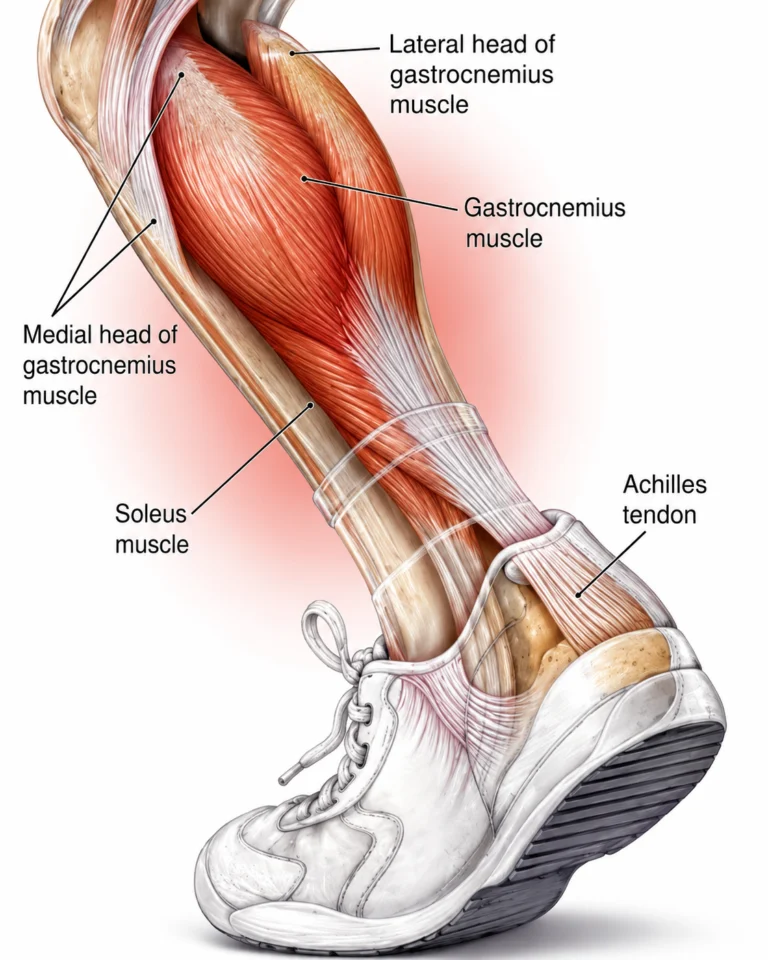
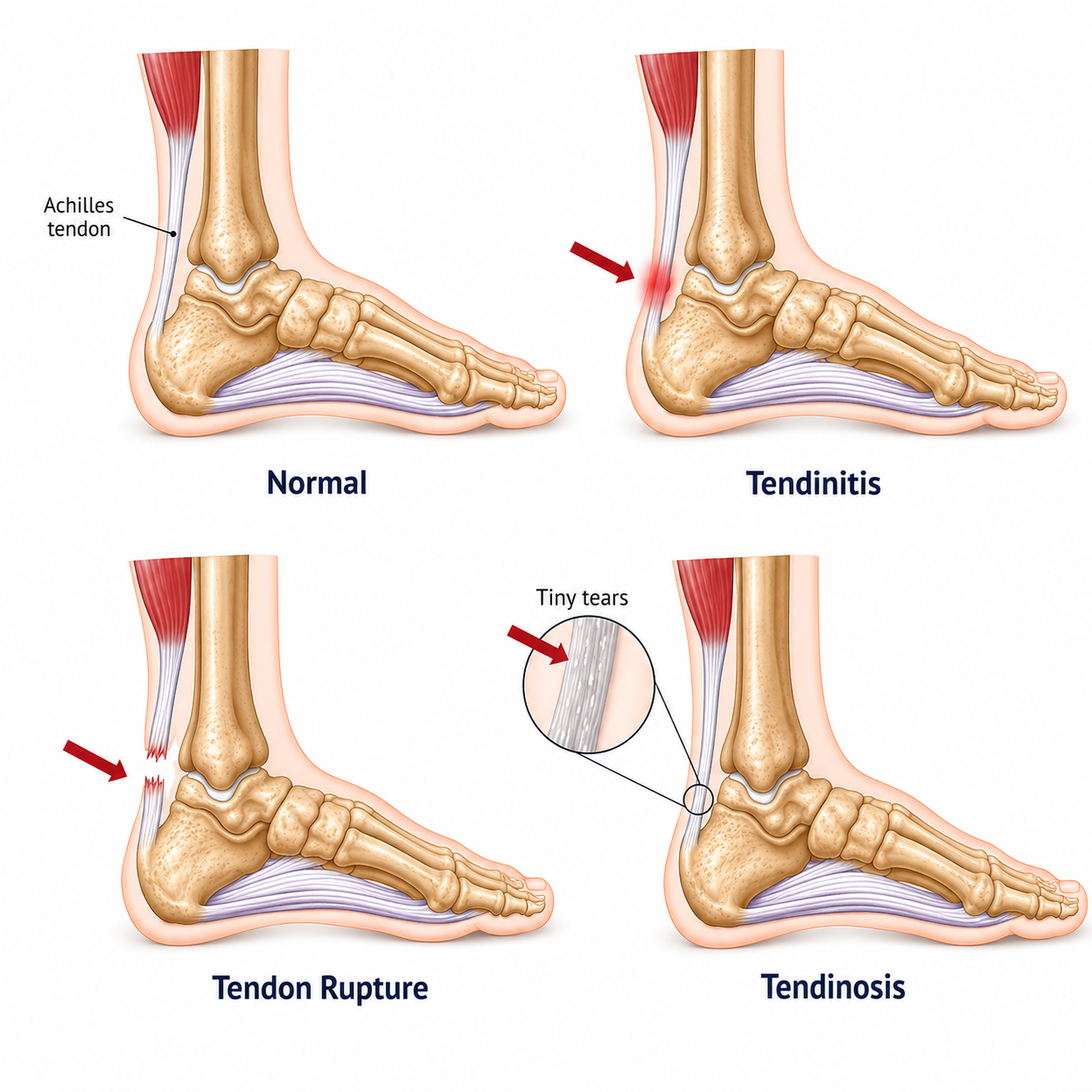
Insertional Achilles tendonitis develops at the exact point where the Achilles tendon attaches to the heel bone. The hallmark symptom is tenderness right at this attachment site, and over time the body may respond by laying down calcium deposits or forming a small bone spur just above the insertion. It's common for this condition to appear alongside retrocalcaneal bursitis, as well as Haglund's deformity — an enlargement of the back of the heel bone that creates a firm bump, sometimes called a "pump bump." Haglund's deformity is seen most often in women who regularly wear high heels, and in hockey players of either sex, where the rigid back of the skate repeatedly rubs against the heel.
Achilles Tendinosis
Achilles tendinosis refers to gradual breakdown of the tendon tissue itself, rather than active inflammation. In fact, most chronic Achilles pain falls into this category — it's driven by degeneration of the tendon's structure and fibers, not swelling. Over time, the tendon can lose strength and integrity.
At Revamp Healthcare in Dwarka, we help patients across Delhi NCR understand what's causing their heel pain and guide them toward the right treatment, from simple lifestyle changes to custom orthotic insoles designed around their foot's specific structure.
Retrocalcaneal Bursitis
Retrocalcaneal bursitis results from repeated movement and irritation of the retrocalcaneal bursa — a small, fluid-filled sac that cushions the space between the heel bone and the Achilles tendon. It causes pain just in front of the tendon, in the narrow area between the tendon and the bone. With overuse or repetitive loading, the bursa can become inflamed, thickened, and even adhere to the tendon itself, so discomfort may be felt either directly on the tendon or in the space just ahead of it. While retrocalcaneal bursitis is linked to rheumatoid arthritis in about 10% of cases, the large majority of cases in athletes affect only one heel and aren't connected to any underlying systemic condition.
Causes & Risk Factors
- Overuse and overload: Suddenly increasing the intensity or duration of a workout, or switching to hard or uneven running surfaces.
- Tight or weak calf muscles: This increases the tension pulled on the Achilles tendon with every step.
- Inappropriate footwear: Shoes without proper heel support & reinforcement or excessive high-heel footwear wear can shorten and stress the tendon.
- Medical Conditions: people having high blood pressure, cholestrol and skin contions like psoriasis are at high risk
- Anatomy: Flat feet (pes planus) or extremely high arches (pes cavus) can cause the tendon to work harder.
- Medication: Fluoroquinolone antibiotics, are known to increase the risk of tendon injury.
Is This What You're Experiencing?
- Pain at the back of the heel, which may be felt directly at the tendon insertion, just in front of the tendon, or along the tendon itself, depending on the specific condition
- Stiffness and pain that are often worse first thing in the morning or after periods of rest, easing somewhat with light activity
- Tenderness to touch over the affected area
- Pain that worsens with activities like running, jumping, or climbing stairs, and with pushing off the foot while walking
- Difficulty wearing certain shoes, particularly those with a rigid or snug heel counter, due to pressure on the irritated area
- Swelling or a visible bump at the back of the heel
Diagnosis and Examination at Revamp Healthcare
An accurate diagnosis starts with a detailed clinical examination. At Revamp Healthcare, this typically includes a review of your symptom history — when the pain began, what activities aggravate it, and whether it came on gradually or after a specific incident — followed by a hands-on assessment of the heel and Achilles tendon.
Your assessment typically starts with a review of your symptom pattern — when the pain started, whether it's worse in the morning, and what activities make it better or worse. This is followed by a physical examination of the foot, checking for tenderness at specific points along the heel and arch, assessing your ankle's range of motion, and observing how you stand and walk. In most cases, this combination is enough to confirm plantar fasciitis without further testing.
During the examination, your clinician will check for:
- The precise location of tenderness — at the tendon insertion, in the space just in front of the tendon, or along the tendon’s midportion — since this helps differentiate between insertional tendonitis, retrocalcaneal bursitis, and tendinosis
- Visible or palpable swelling, thickening, or bony prominence at the back of the heel
- Range of motion at the ankle, and whether stretching or resisted movement reproduces the pain
- Gait and foot alignment, including how the foot strikes the ground and whether biomechanical issues (such as overpronation or tight calf muscles) may be contributing
- Signs that may point to a more significant tendon injury, such as a palpable gap in the tendon or weakness with push-off, which would warrant urgent evaluation for a possible rupture
When Imaging is Used?
Where the diagnosis isn't clear from the exam alone, or where symptoms are longstanding or severe, imaging may be recommended to confirm the extent of the problem and rule out other causes:
X-rays are useful for identifying bone spurs, calcification at the tendon insertion, or a Haglund's deformity
Ultrasound can help visualize tendon thickening, degeneration, or bursal inflammation in real time, and allows the area to be assessed under movement or pressure
MRI may be used in more complex or persistent cases to assess the internal structure of the tendon, distinguish between inflammation and degeneration, and evaluate for partial tears
Based on the findings, your clinician will confirm the specific diagnosis — or combination of diagnoses, since these conditions frequently coexist — and use this to guide an individualised treatment plan, which may include activity modification, orthotic support, physical therapy, or referral for further intervention where needed.
How Revamp's Custom Insoles Help?
For many people with Achilles tendon disorders, footwear and foot mechanics play a direct role in how much stress the tendon is under with every step. At Revamp Healthcare, custom insoles are designed around your specific foot structure and gait to help reduce that strain and support recovery.
- Heel elevation to offload the tendon. A built-in heel lift shortens the distance the Achilles tendon has to stretch with each step, reducing tension at the insertion point and along the tendon body — particularly helpful during the acute or painful phase of tendonitis, tendinosis, or retrocalcaneal bursitis.
- Correcting alignment issues. Many Achilles problems are aggravated by underlying biomechanical patterns, such as overpronation (the foot rolling inward excessively) or poor arch support. A custom insole is built to control this movement, keeping the foot and ankle better aligned and reducing the abnormal pull placed on the tendon during walking, running, or standing.
- Distributing pressure away from irritated areas. For conditions like retrocalcaneal bursitis or insertional tendonitis, where a specific spot at the back of the heel is inflamed or tender, an insole can be shaped to reduce direct pressure and friction in that exact area, including around a Haglund’s deformity if present.
- Supporting the arch to reduce compensatory strain. Because the Achilles tendon works closely with the arch and calf muscles during movement, proper arch support reduces the extra load the tendon has to absorb when the foot’s natural mechanics aren’t functioning efficiently.
- A tailored fit, not a generic solution. Unlike off-the-shelf insoles, Revamp’s custom insoles are built from an individual assessment of your foot shape, gait pattern, and specific diagnosis, so the correction is matched precisely to what’s driving your symptoms — rather than a one-size-fits-all approach.
Custom insoles are often used alongside other elements of your treatment plan — activity modification, stretching, and strengthening — as part of a broader, individualised approach to recovery rather than as a standalone fix.
Prevention and Care
Most Achilles tendon injuries develop gradually, which means they're also largely preventable with the right approach to training and daily care.
- Progress gradually. Whether you’re starting a new activity or returning after time off, build up duration and intensity slowly rather than jumping straight into hard training.
- Respect your limits. Avoid high-strain activities like hill running until your tendon has adapted to lower-intensity training. Always warm up at an easy pace before harder efforts, and if you feel pain during exercise, stop and rest rather than pushing through it.
- Wear supportive footwear. Choose shoes that cushion the heel and offer firm arch support to reduce tension on the Achilles tendon. Replace shoes once they’re worn out, and if a shoe fits well but lacks support, consider adding arch supports or custom insoles.
- Stretch consistently. Stretching the calf muscles and Achilles tendon each morning, and before and after exercise, helps keep the tendon flexible and lowers the risk of both first-time injury and recurrence.
- Build calf strength. Strong calf muscles share the load with the Achilles tendon, helping it withstand the demands of running, jumping, and other high-impact activity.
- Cross-train. Avoid high-impact activities like running or jumping every single day. Alternate with lower-impact options such as cycling or swimming to give the tendon time to recover between sessions.
For athletes and highly active individuals, these principles matter even more, since training loads are higher and recovery windows are often shorter:
- Progress training load deliberately — increase intensity, duration, or difficulty in small, planned increments rather than large jumps
- Prioritise footwear with proper arch support, since this directly reduces strain on the heel and surrounding muscles
- Make stretching a non-negotiable part of training, both before and after every session, to keep the Achilles tendon and calf muscles loose and resilient arch support to reduce tension on the Achilles tendon. Replace shoes once they’re worn out, and if a shoe fits well but lacks support, consider adding arch supports or custom insoles.
Frequently Asked Questions
Reviewed By Dr Mohit Sharma - Clinical Head, Podiatrist, Foot Care Specialist on 22 July 2026
Book Your Appointment
Book a foot assessment with our team in Dwarka and get a clear answer on what’s causing your pain — and a plan to actually fix it.