Contact Us : +91 9599564689 | Email: info@revamphealthcare.in | Working Hours : Mon-Sat, 10 AM-8PM

Leg Length Discrepancy (LLD) Treatment in Delhi NCR
Expert Assessment, Custom Shoe Lifts & Orthotic Solutions
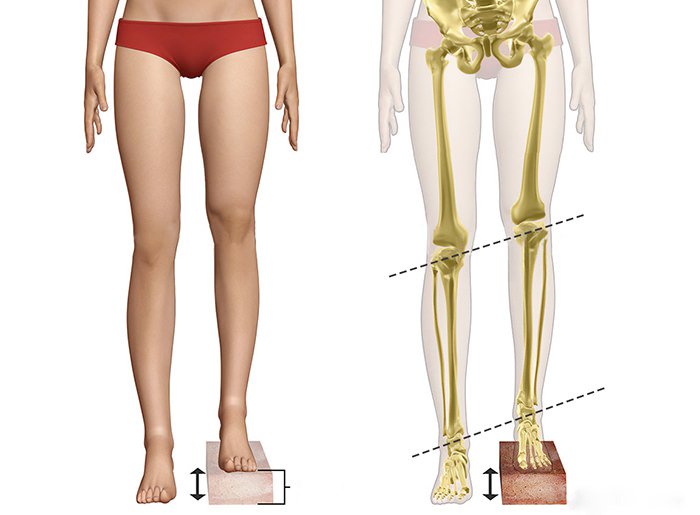
Leg Length Discrepancy (LLD), also known as unequal leg length or limb length inequality, is a condition in which one leg is shorter than the other. Even a small difference in leg length can affect the way you stand, walk, and move. Over time, this imbalance may place extra stress on the feet, knees, hips, pelvis, and spine, leading to pain and poor posture.
At Revamp Prosthetics & Orthotics, we provide comprehensive evaluation and personalized treatment for leg length discrepancy using advanced gait analysis, custom orthotic solutions, shoe modifications, and rehabilitation strategies. Our goal is to restore body alignment, reduce pain, and improve your walking efficiency.
What is Leg Length Discrepancy?
Leg Length Discrepancy (LLD) occurs when one lower limb is shorter than the other. The difference may involve the femur (thigh bone), tibia (shin bone), foot height, or a combination of these structures.
Many people have a very small difference in leg length that causes no symptoms. However, larger discrepancies can significantly affect posture, gait, joint loading, and overall mobility. LLD can affect both children and adults and may be present from birth or develop later due to injury or disease.
Types of Leg Length Discrepancy
Structural (Anatomical) Leg Length Discrepancy
Structural LLD occurs when there is an actual difference in bone length between the legs.
Common causes include:
Functional Leg Length Discrepancy
In functional LLD, both legs are equal in bone length, but one leg functions as though it is shorter because of alignment or movement abnormalities.
Possible causes include:
Unlike structural LLD, functional discrepancies can often improve significantly with appropriate treatment.
Symptoms of Leg Length Discrepancy
Symptoms vary depending on the amount of discrepancy and how long it has been present.
Common symptoms include:
Children may also develop abnormal posture or compensatory walking patterns as they grow.
Causes of Leg Length Discrepancy
Leg length differences may develop due to several conditions, including:
Congenital Causes
Acquired Causes
How Leg Length Discrepancy Affects the Body
Proper assessment helps determine whether these symptoms are actually related to leg length difference or another underlying condition.
When Should You See a Specialist?
Early assessment helps identify whether the condition is developmental or pathological.
Diagnosis of Leg Length Discrepancy
Accurate diagnosis is essential before beginning treatment.
Our assessment includes:
Clinical Examination
Block Test
Blocks of different heights are placed beneath the shorter leg until the pelvis becomes level. This simple method helps estimate the amount of discrepancy.
Gait Analysis
Walking mechanics are evaluated to identify:
Imaging (When Required)
If necessary, your doctor may recommend:
Leg Length Discrepancy Treatment at Revamp Prosthetics & Orthotics
Treatment depends on:
Our approach focuses on improving comfort, restoring alignment, and reducing abnormal joint stress.
Custom Shoe Lifts
For many patients, a custom shoe lift is the most effective conservative treatment.
Each lift is individually designed based on precise measurements.
Custom Orthotics
Custom foot orthoses help optimize lower limb biomechanics and improve weight distribution.
They are especially useful when leg length discrepancy is associated with:
Footwear Modification
Our specialists provide professional shoe modifications, including:
Gait Training
We help patients develop a more efficient walking pattern by correcting compensatory movements and improving lower limb alignment.
When is Surgery Needed?
Most mild to moderate leg length discrepancies can be managed conservatively.
Surgery may be considered when:
Depending on age and severity, surgical options may include:
Why Choose Revamp Prosthetics & Orthotics?
We combine clinical expertise with advanced technology to deliver personalized care for patients of all ages.
Our services include:
Every solution is customized according to your individual anatomy, activity level, and lifestyle.
Reviewed By Dr Mohit Sharma - Clinical Head, Podiatrist, Foot Care Specialist on 22 July 2026