Sever's Disease (Calcaneal Apophysitis): Causes, Symptoms & Treatment in Dwarka, Delhi
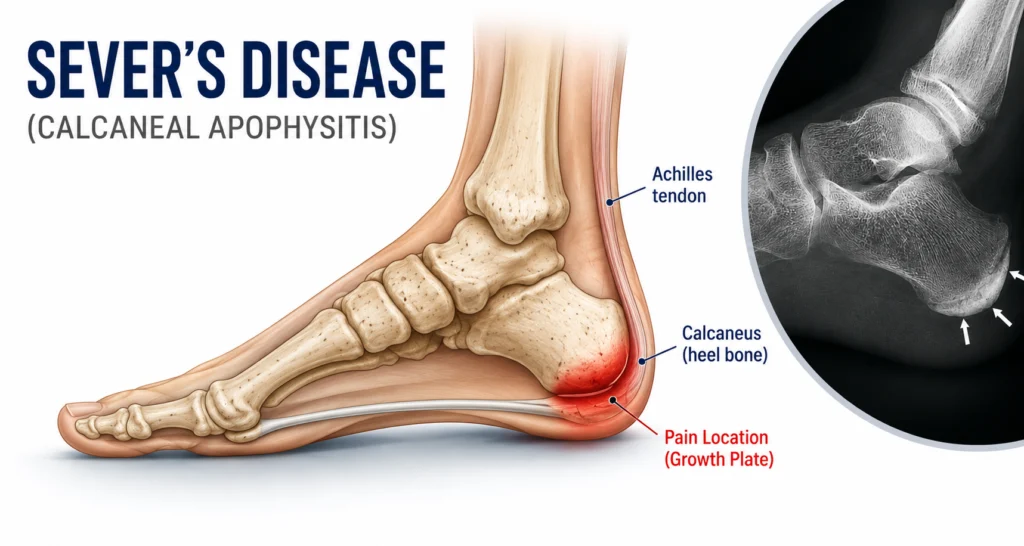
image showing location of pain in sever's disease and also the appreance of it under x rays

What Is Sever's Disease?

Sever's disease — the clinical term is calcaneal apophysitis — is inflammation of the growth plate in a child's heel bone. Despite the name, it isn't a disease in the traditional sense; it's an overuse injury that happens during growth spurts, when bone is still forming and more vulnerable to repetitive strain.It's one of the most common causes of heel pain in active children, typically appearing during the rapid-growth years of early puberty — generally ages 8 to 14, with peak incidence around 8–10 in girls and 10–12 in boys. The good news: with the right management, it resolves without any lasting effect on the foot.

Why It Happens

During a growth spurt, bones often lengthen faster than the muscles and tendons attached to them can stretch to keep up. This creates tightness — particularly in the Achilles tendon — which pulls on the heel's growth plate with every step, run, or jump. Since growth-plate bone is still forming from cartilage, it's softer and more prone to irritation than mature bone.Repetitive impact from running and jumping sports accelerates this, which is why it's especially common in children active in basketball, athletics, gymnastics, and similar sports, particularly on hard surfaces. Foot mechanics can also play a role — some children develop it even with relatively low activity levels, suggesting factors like limited ankle flexibility, flat feet, or overpronation contribute independently of training volume.

Symptoms to Watch For

  • Pain in one or both heels (many children report both)
  • Pain when the heel is squeezed from side to side
  • Limping, walking on tiptoes, or an altered running gait
  • Stiffness in the heel, especially first thing in the morning
  • Mild swelling or redness around the heel
  • Pain that worsens with activity and eases with rest

When to See a Podiatrist

Book an assessment if your child shows:

  • Heel pain that persists beyond a few days of reduced activity
  • Limping or a noticeable change in how they walk or run
  • Pain that returns quickly once activity resumes
  • Swelling, warmth, or redness around the heel

A prompt assessment matters mainly for comfort and speed of recovery — Sever's disease itself isn't dangerous, but ruling out other causes of heel pain (like a stress fracture) is worth confirming early.

How It's Diagnosed

Sever's disease is typically diagnosed clinically — through a physical exam and activity history — rather than through imaging. A common test is gentle side-to-side compression of the heel (a "squeeze test"), which reproduces the pain if Sever's disease is present.
X-rays don't reliably show the condition itself, but may be used to rule out other causes of heel pain, such as a stress fracture or bone cyst.

How Sever's Disease Is Treated

Treatment focuses on reducing the strain on the heel while the growth plate settles — not on "toughing it out."

Conservative care (first-line)

  • Activity modification — reducing or pausing sports and activities that trigger pain; low-impact options like swimming or cycling are usually fine in the meantime
  • Ice — applied for about 15–20 minutes every few hours during flare-ups, always with a cloth barrier to protect the skin
  • Pain relief — age-appropriate over-the-counter medication such as paracetamol or ibuprofen, as advised
  • Heel cups or custom orthotic inserts — cushioning and shock absorption to reduce direct pressure and pull on the heel
  • Supportive footwear — well-cushioned shoes; open-backed styles can help avoid direct heel irritation
  • Stretching and physical therapy — targeted calf and Achilles stretches to relieve tension on the growth plate, along with strengthening exercises where recommended

In more severe or persistent cases, a walking boot or short-term cast may be used to fully offload the heel while it heals.

Outlook

Most children improve within a few weeks to a couple of months with consistent rest and care, and go on to return to their usual sports and activities without any lasting effect. If the underlying strain isn't addressed, symptoms can persist on and off until the growth plate finishes maturing — usually by around age 15, after which Sever's disease cannot recur.

Preventing Recurrence

  • Choose well-fitted, well-cushioned footwear; avoid heavy or high-heeled shoes
  • Build in regular stretching before and after sports, particularly for the calves and Achilles
  • Use ice after activity as a preventive habit during active growth years
  • Custom shoe inserts can reduce heel strain in children prone to flare-ups, especially where flat feet or overpronation are contributing factors
  • Maintain a healthy weight, since excess load adds to heel stress
  • Encourage your child to speak up about heel pain early rather than pushing through it

Frequently Asked Questions

Is Sever's disease serious?

No — it’s uncomfortable but not dangerous, and it doesn’t cause lasting damage to the foot. It resolves on its own once the growth plate finishes developing, typically by around age 15.

Can my child keep playing sports with Sever's disease?

Only if the activity doesn’t cause pain. Continuing to play through pain tends to prolong symptoms rather than “toughen through” them — the standard guidance is to modify or pause activities that trigger discomfort.

Do custom insoles actually help?

Yes, particularly for children with flat feet, tight calves, or overpronation — supportive inserts reduce the repetitive pull and impact on the heel’s growth plate, which can meaningfully ease symptoms and lower recurrence risk.

Will Sever's disease come back once it's healed?

It’s possible during the remaining growth years if triggering activity resumes too quickly. Once the growth plate fully closes (usually around age 15), the condition cannot recur.

At Revamp Healthcare, Dwarka Sector 14, our podiatry team assesses your child's foot mechanics and gait to identify contributing factors behind recurring heel pain, and can recommend custom inserts designed for growing feet.

Last Update

Reviewed By Dr Mohit Sharma - Clinical Head, Podiatrist, Foot Care Specialist on 22 July 2026

Book Your Appointment

Book a foot assessment with our team in Dwarka and get a clear answer on what’s causing your pain — and a plan to actually fix it.