Overpronation: Causes, Symptoms & Treatment in Dwarka, Delhi
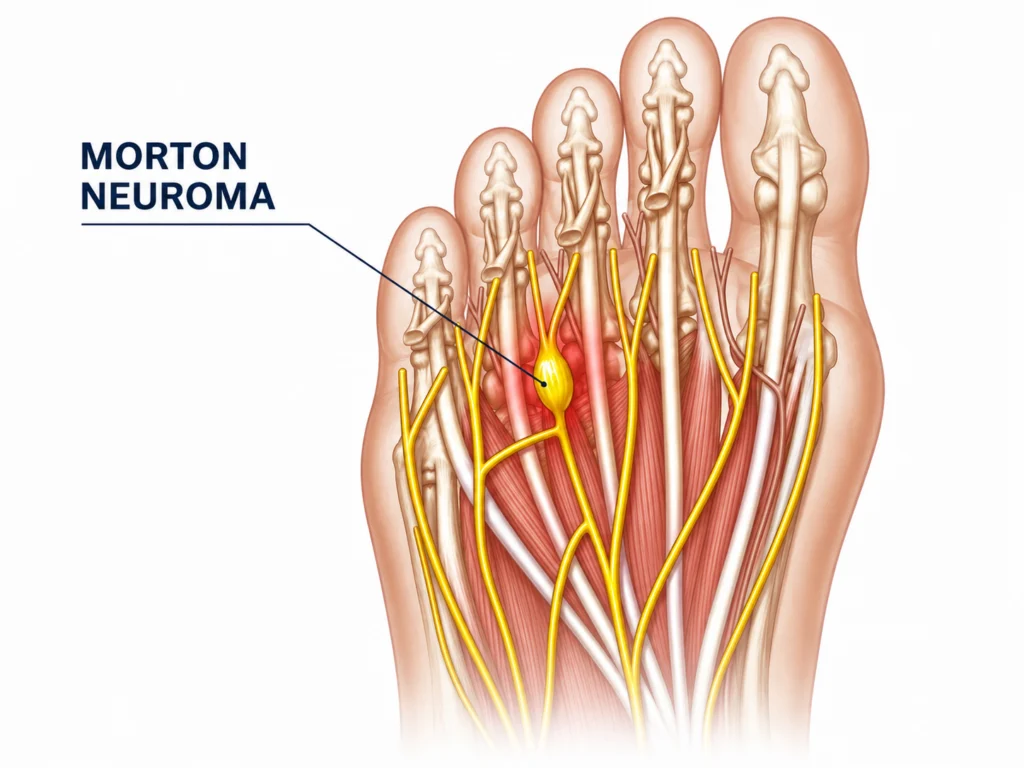
site of formation of morton's neuroma

What Is Overpronation?

Every foot pronates a little — it's a normal part of walking. As your heel strikes the ground and weight shifts forward, your arch flattens slightly to absorb the impact before pushing off through the ball of your foot. That controlled flattening is what protects your joints from shock.
Overpronation is when this rolling-inward motion goes too far. Instead of absorbing impact and returning to a stable position, the arch collapses excessively, and the foot rolls further inward than it should. Over time, that extra inward roll puts strain on the muscles, tendons, and ligaments that are meant to support your arch — and the effects don't always stay confined to the foot.

How to Tell If You Overpronate

  • Check your shoe soles. If the inner edge is more worn down than the outer edge, that’s a classic sign.
  • Look at your bare, wet footprint. A normal footprint shows the heel connecting to the toes through roughly half the foot’s width. In overpronation, the print fills in across nearly the full width of the foot.
  • Stand and look down. Very little visible arch space between your foot and the floor can indicate a flattened arch pattern.
  • Trace the shin line. If an imaginary line from your knee to your ankle drifts toward the inside of your foot rather than toward your first or second toe, that’s another indicator.

A podiatrist can confirm this more precisely through a gait assessment with video analysis & pressure-mapping — rather than relying on self-checks alone.

What Causes Overpronation

  • Flexible or flat arches — the most common underlying factor; some people are simply born with more flexible arches
  • Weight-bearing conditions — pregnancy or excess body weight increase load on the arch
  • Tendon strain — damage or inflammation in the posterior tibial tendon, which supports the arch, can cause it to collapse over time (adult-acquired flatfoot)
  • High-impact activity — repeated hard-surface running or walking accelerates strain on arch-supporting structures
  • Joint or nerve conditions — arthritis affecting foot joints, or nerve conditions (including diabetes-related neuropathy) that reduce the ability to feel the arch collapsing

What Overpronation Can Lead To

Because overpronation changes how force travels through your foot and up your leg, it's linked to a wide range of downstream issues — which is why it's often the "root cause" behind seemingly unrelated pain:

  • Plantar fasciitis and heel pain
  • Corns and calluses, especially near the big toe and first metatarsal head
  • Bunions and hammertoes
  • Shin splints and Achilles tendinitis
  • Knee pain and iliotibial band syndrome
  • Hip and lower back pain

This is why a podiatrist assessing recurring heel pain or calluses will often check your gait — the visible symptom and the actual cause aren't always in the same place.

When to See a Podiatrist

  • Persistent foot, ankle, or leg pain that doesn’t ease with rest
  • Recurring injuries like shin splints, plantar fasciitis, or ankle sprains
  • Only one foot appears flat, or flat feet developed suddenly in adulthood
  • Numbness, weakness, or balance difficulty alongside the arch changes

How Overpronation Is Treated

  • Gait assessment — identifying exactly how and where your foot rolls inward
  • Custom orthotic insoles — built to support the arch and correct the degree of inward roll during walking and running; this is generally the most effective single intervention
  • Supportive or motion-control footwear — shoes with a firm heel counter and a supportive midsole to limit excess rolling
  • Targeted strengthening exercises — to build arch and hip stability and reduce reliance on passive support alone
  • Pain management — ice or anti-inflammatory medication for any associated joint or tendon pain
  • Weight management, where relevant, to reduce load on the arch

Over-the-counter insoles offer some support, but custom orthotics — built from your own gait and pressure pattern — correct the specific degree and direction of your overpronation, rather than offering generic arch support.

Prevention

  • Choose shoes with a firm heel counter, supportive midsole, and a wide base — often labelled “stability” or “motion control” shoes
  • Replace running or walking shoes before they wear out, especially if the inner sole shows heavy wear
  • Maintain a healthy body weight to reduce arch strain
  • Where high-impact activity is unavoidable, favour softer surfaces over concrete or hard pavement
  • If you have a history of flat feet or related pain, get a gait assessment early rather than waiting for pain to appear

Frequently Asked Questions

Is overpronation the same as flat feet?

Related, but not identical. Flat feet describes the foot’s structure — a low or absent arch. Overpronation describes the way the foot moves, and it’s what can cause flat feet to develop or worsen over time.

Can overpronation be fixed permanently?

It can be effectively managed and its downstream effects prevented, mainly through custom orthotics and supportive footwear. In most adults, it’s a mechanical pattern that’s controlled rather than “cured,” similar to needing glasses for vision.

Do I need custom insoles, or will over-the-counter ones work?

Over-the-counter insoles can help mild cases. If you have persistent pain, recurring injuries, or a pronounced inward roll, custom insoles built around your specific gait typically offer more precise, lasting correction.

Can overpronation cause pain in my knees or back, even if my feet don't hurt?

Yes — this is one of the more overlooked patterns. Because overpronation changes how force travels up the leg, some people experience knee, hip, or back pain with little to no foot discomfort at all.

Last Update

Reviewed By Dr Mohit Sharma - Clinical Head, Podiatrist, Foot Care Specialist on 22 July 2026

Book Your Appointment

Book a foot assessment with our team in Dwarka and get a clear answer on what’s causing your pain — and a plan to actually fix it.