Contact Us : +91 9599564689 | Email: info@revamphealthcare.in | Working Hours : Mon-Sat, 10 AM-8PM

Flat Feet Treatment in Dwarka — Arch Support, Custom Insoles & Footwear Advice
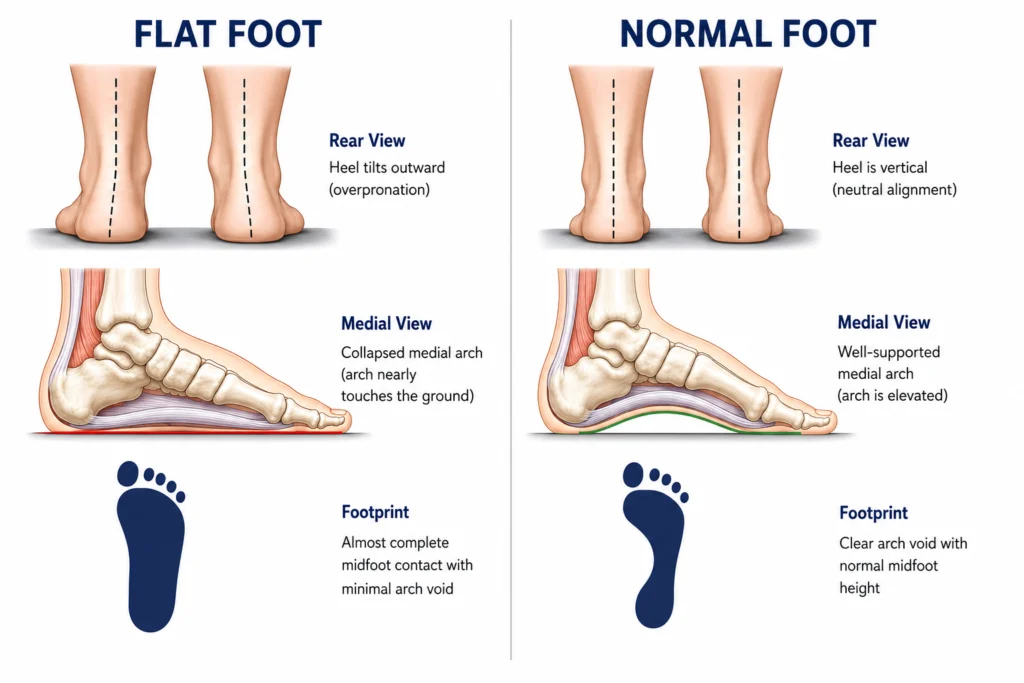
What is Flat feet?
Flat feet, or pes planus, is a common condition where the arch on the inside of the foot flattens under weight — causing the foot to point outward and the arch to lower or touch the ground when standing. It's also known as progressive collapsing foot deformity, and is sometimes linked to hyperpronation or overpronation.
Flat feet can be present from childhood, when the arches never fully develop, or can develop later in life due to injury or age-related wear and tear. Many people with flat feet experience no pain at all and require no treatment. For others, it can contribute to problems such as heel pain, arch pain, or ankle swelling — in which case an evaluation is recommended.
Causes
Flat feet can be congenital or acquired
Why do my foot Arch matters?
The arch of the foot isn't just a structural feature — it plays a functional role in how the entire lower body absorbs impact and moves.
Is This What You're Experiencing?
The signs and symptoms of having flat feet are:
Symptoms often worsen with prolonged standing, walking, or high-impact activity, and tend to improve with rest. If pain, swelling, or activity limitation develops, an evaluation is recommended to identify any underlying cause and appropriate treatment
How Flat feet Progresses?
Flat feet tend to worsen gradually with continued exposure to weight-bearing activity, most commonly progressing in one of two directions: bony stress injuries or foot deformities.In active individuals, hyperpronation alters how load travels up through the leg with each step. Over time, this altered load transfer can lead to stress responses such as shin splints, and in more severe cases, stress fractures.
At the other end, altered loading through the foot itself can contribute to bunion formation. As the arch collapses and the midfoot pronates, the line of force shifts toward the outside of the first metatarsal. This pushes the metatarsal head outward while forcing the big toe inward — the combination that produces a bunion, with prolonged pronation gradually accentuating the deformity over time.
What conditions can Flat Feet cause?
Without proper rehabilitation, ongoing instability from flat feet can place abnormal load on nearby structures, leading to a range of compounding problems:
Getting the Right Diagnosis First
Since flat feet often involve underlying biomechanical factors — and can progress to affect the knees, hips, and lower back — a thorough assessment looks well beyond just the visible arch.
Clinical Examination
Your assessment typically starts with a review of your symptom pattern — when the pain started, whether it's worse in the morning, and what activities make it better or worse. This is followed by a physical examination of the foot, checking for tenderness at specific points along the heel and arch, assessing your ankle's range of motion, and observing how you stand and walk. In most cases, this combination is enough to confirm plantar fasciitis without further testing.
Foot Posture Index (FPI). A clinical scoring system used to objectively grade the degree of pronation or arch collapse, based on a structured set of observations of the foot in standing. This gives a standardised, measurable baseline of severity rather than relying on visual impression alone, and allows progress to be tracked over time.
Foot pressure scan. Measures how weight is distributed across the foot during standing and walking, highlighting areas of excess pressure — commonly under the arch, heel, or first metatarsal — that may be driving pain or contributing to secondary issues like bunions or calluses.
Gait analysis. Assesses how the foot, ankle, and leg move together through a full walking or running cycle, identifying excessive pronation, timing issues, or compensatory movement patterns that static assessment alone can miss.
Postural analysis. Looks at alignment beyond the foot itself — including the ankle, knee, and hip — since flat feet frequently influence, and are influenced by, alignment further up the kinetic chain.
Together, these assessments allow your clinician at Revamp Healthcare to build a complete picture of not just how flat the arch is, but how it's affecting movement and load distribution throughout the body — forming the basis for a treatment plan that addresses the underlying cause, not just the visible arch collapse
Because heel pain can also be caused by nerve compression, stress fractures, or inflammatory joint conditions, your specialist may ask additional questions or, in select cases, recommend blood tests to rule out inflammatory causes — particularly if both feet are affected or the pain doesn't follow the typical plantar fasciitis pattern.
Treatment & Recovery
Treatment for flat feet depends largely on the underlying cause and whether the condition is actually causing pain or functional limitation. If your feet aren't causing discomfort, no treatment is necessary — flat feet alone don't require intervention. When treatment is needed, the goal is to reduce pain, improve foot function, and prevent progression, using an approach tailored to your specific biomechanics and severity:
![image showing how custom insoles help in better biomechanical alignment]](https://revamphealthcare.in/wp-content/uploads/2026/07/how-custom-insoles-improves-posture.webp "how custom insoles improves posture")