Contact Us : +91 9599564689 | Email: info@revamphealthcare.in | Working Hours : Mon-Sat, 10 AM-8PM

Plantar Fasciitis Treament near Gurgaon, Delhi NCR, India
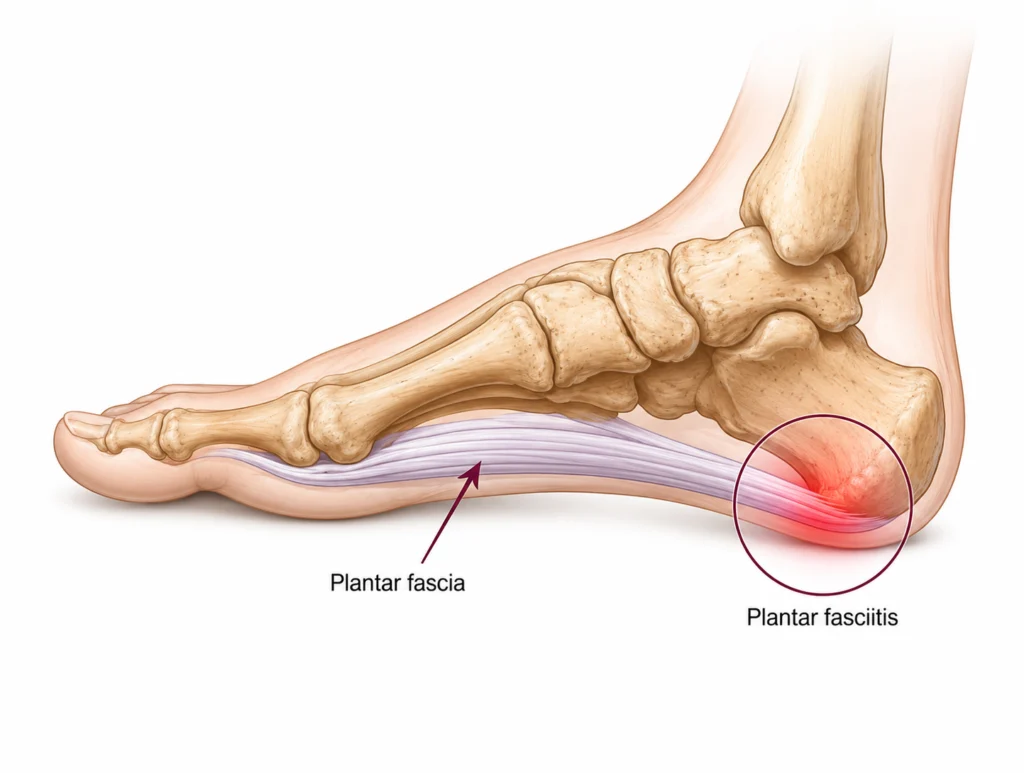
Plantar Fasciitis
If you feel a sharp pain in your heel with your very first steps in the morning, or after sitting for a while, you may be dealing with plantar fasciitis — one of the most common causes of heel pain. It happens when the plantar fascia, a thick band of tissue that runs along the bottom of your foot, becomes irritated or develops small tears from repeated strain.
The resulting inflammation of Plantar fascia called as Plantar Fasciitis. It can affect anyone — people on their feet all day, walkers, runners, or those with flat feet or high arches — and left untreated, it tends to get worse rather than better on its own.
At Revamp Healthcare in Dwarka, we help patients across Delhi NCR understand what's causing their heel pain and guide them toward the right treatment, from simple lifestyle changes to custom orthotic insoles designed around their foot's specific structure.
What Causes Plantar Fasciitis?
Plantar fasciitis develops when the plantar fascia — the band of tissue supporting your arch — is put under repeated strain until it develops tiny tears and becomes irritated. Mechanism of injury could be traction (overstretch) or compression of fascia.
Many people assume heel spurs cause plantar fasciitis, but the relationship isn't that direct — plenty of people with heel spurs have no pain at all, and plenty of people with plantar fasciitis have no spur. Spurs are better understood as something that can develop after prolonged strain, not the root cause of the pain itself. Learn more about Heel Spurs.
Is This What You're Experiencing?
The clearest sign of plantar fasciitis is a pattern, not just the pain itself:
Why Waiting Makes It Harder to Treat
Plantar fasciitis rarely resolves on its own once it reaches the point where pain is increasing daily. Left untreated, the strain on the fascia can lead to compensatory pain in the knees, hips, or lower back, as your gait changes to avoid the pain. The earlier it's properly assessed, the fewer complications and the faster the recovery.
If plantar fasciitis is left untreated and the strain on the fascia continues, the tissue can eventually respond by laying down calcium deposits at the point where it attaches to the heel bone. Over time, this can develop into a bony growth known as a heel spur. Once a heel spur forms, recovery generally takes longer and treatment needs to be more targeted, which is another reason to address plantar fasciitis early rather than let it progress.
Getting the Right Diagnosis First
Plantar fasciitis is usually diagnosed clinically — meaning a qualified physiotherapist or foot specialist can identify it through your symptom history and a physical examination, without needing scans in most cases. Imaging is reserved for situations where the diagnosis isn't clear-cut or another condition needs to be ruled out.
Clinical Examination
Your assessment typically starts with a review of your symptom pattern — when the pain started, whether it's worse in the morning, and what activities make it better or worse. This is followed by a physical examination of the foot, checking for tenderness at specific points along the heel and arch, assessing your ankle's range of motion, and observing how you stand and walk.
In most cases, this combination is enough to confirm plantar fasciitis without further testing.
When Imaging is Used?
Scans aren't routinely needed to diagnose plantar fasciitis, but your specialist may recommend them if your pain hasn't improved after a few months of treatment, or if your symptoms suggest something other than plantar fasciitis could be involved.
X-rays can show whether a bony growth (heel spur) has formed where the fascia attaches to the heel bone. It's worth knowing that a heel spur on its own doesn't confirm plantar fasciitis — many people have spurs with no pain at all, and many people with plantar fasciitis have no spur. X-rays are more useful for ruling out other causes of heel pain, such as a stress fracture.
Ultrasound can show thickening or inflammation of the plantar fascia and is a quick, non-invasive way to confirm the diagnosis when there's uncertainty.
MRI is used less often, typically reserved for cases where a partial or complete tear of the fascia is suspected, or when symptoms haven't responded to initial treatment and a more detailed picture is needed.
Ruling out other Conditions
Because heel pain can also be caused by nerve compression, stress fractures, or inflammatory joint conditions, your specialist may ask additional questions or, in select cases, recommend blood tests to rule out inflammatory causes — particularly if both feet are affected or the pain doesn't follow the typical plantar fasciitis pattern.
Understanding the root cause
A thorough assessment doesn't stop at confirming plantar fasciitis — it also looks at why your fascia is under strain in the first place, whether that's your foot's arch type, your gait, your footwear, or a combination of factors.
This is what allows a treatment plan to be built around preventing the problem from returning, rather than only addressing the current pain.
Treatment & Recovery
Most cases of plantar fasciitis improve with conservative, non-surgical care. Treatment usually works best as a combination of approaches rather than relying on just one, and recovery timelines vary depending on how long the pain has been present before treatment starts.
While you wait for your appointment, there's also a lot you can safely do at home to ease discomfort in the meantime.
Easing pain in the early stages
Supportive Footwear and Custom insoles for Plantar fasciitis
Footwear plays a bigger role in recovery than most people expect. Shoes with a firm heel support and a stable sole reduce strain on the fascia with every step, while soft, flexible, or worn-out shoes tend to make symptoms worse.
Arch supports — whether over-the-counter or custom-made — can meaningfully reduce pain for many patients, particularly those with flat feet, by correcting how weight is distributed across the foot. Custom orthotics tend to last longer and are shaped specifically to your foot's structure, which matters more for chronic or recurring cases
Night Splints
Most people sleep with their feet pointed slightly downward, which allows the plantar fascia to shorten overnight — this is part of why the first steps out of bed are often the most painful.
Night splints hold the foot at a neutral angle through the night, keeping gentle, constant tension on the fascia so it doesn't tighten as much while you sleep. They're typically recommended for a period of one to three months in cases where morning pain is a consistent symptom.
Return to Activity Safely
Lifestyle Changes
Reviewed By Dr Mohit Sharma - Clinical Head, Podiatrist, Foot Care Specialist on 22 July 2026